

New Hampshire Car Accident Attorney Ready to Fight for You
Holding Negligent Drivers Accountable Under New Hampshire's Motor Vehicle Laws
As an experienced NH personal injury lawyer, Attorney Keith F. Diaz helps victims of auto accidents, motorcycle crashes, and trucking collisions. He represents clients across Manchester, Bedford, and Goffstown.
Experienced New Hampshire
Car Accident Attorney
Since 2003 Attorney Keith F. Diaz has represented people injured in car accidents across New Hampshire, from rear-end collisions with hidden soft-tissue injuries to catastrophic highway crashes involving uninsured or underinsured drivers to multi-vehicle crashes on I-93. He understands how insurance adjusters use New Hampshire's comparative fault rule to shift blame onto you — even a few extra percentage points can slash your recovery, and if they push your fault above 50%, they pay nothing. Attorney Diaz knows how to defeat that strategy.
New Hampshire law requires every driver to keep a proper lookout, maintain control, and drive at a speed reasonable for conditions. The NH Supreme Court has held that this duty includes not only the obligation to look, but also the obligation to look carefully to observe oncoming traffic. See Johnston v. Lynch, 133 N.H. 79 (1990). When a driver breaches that duty, and you are injured, you have the right to recover full, fair, and adequate compensation. We explain how NH courts evaluate driver negligence, the specific legal duties every driver owes you, New Hampshire's comparative fault rule and how insurers exploit it, the types of damages you can recover, and what to do in the hours and days after a crash to protect your claim.

Your Advocate, Counselor, Litigator
At Apis Law, every case starts with a free, no-obligation consultation. Attorney Diaz will review the details of your accident, explain your options in plain language, and give you an honest assessment of what your case may be worth. You pay nothing unless we win. Serving clients throughout New Hampshire from our Goffstown and Bedford offices, including Manchester, Nashua, Concord, Hooksett, and New Boston.
Credentials Bar:
Since 2003: handling NH car accident cases | Five-star reviews from real clients | No fee unless we win — contingency basis only | Direct access to your attorney — you work with Keith, not a case manager
Free Case Evaluation
Ready to Fight for Your Rights?
Sometimes, doing life can be hard on your own. Don't let your adversary gain the upper hand. Apis Law is your advocate, counselor, and litigator. Reach out today — you don't have to face this alone.
Serving clients in personal injury, employment, and real estate matters
✅ Free consultation with no obligation
✅ No upfront costs or fees
✅ Available 24/7 for emergencies
WHAT PEOPLE SAY
We had an overwhelmingly positive experience with Atty. Diaz in settling our personal injury claim after a roll-over accident involving a drunk driver. Throughout the entire legal process he was attentive and patient with our questions (our first time with legal counsel), had excellent and clear communication, and was thoroughly professional. Atty. Diaz genuinely cared about our case and we absolutely owe our successful settlement to his work. We settled for a significantly higher amount than we had anticipated due to his diligence, persistence, and skill.
Scott Chamberlin
Best decision I made was calling Keith after my motor vehicle accident he made the process easy and stress free but more than that he was a kind and caring. I highly recommend apis law and Keith. Thank you for everything
Bobby Fitts
Keith was a total delight to work with. After an auto accident he went way beyond my expectations. I'd recommend him in a flash. Thank you Keith'.
Jerry Plouffe
I was rear-ended last year by a careless driver. After many unsuccesful attempts by me at trying to get a reasonable settlement out of their insurance company I reached out to Keith. Keith is excellent attorney, clearly explained my options and managed my claim to a successful conclusion. I can recommend Keith without reservation.
Michael Patz
Apis Law (Keith) was great in helping me with a motor vehicle accident injury, I am extremely satisfied with his assistance and professionalism. He's an excellent attorney and I highly recommend him.
g Chambers
Apis Law is very professional, dedicated and knowledgeable. Keith took my Auto Accident case and got the best deal from the other party who was responsible for the accident. He was very thorough and always informed me of every decision that was presented to him. Great Attorney to work with for Auto cases.
Karine P
After an auto accident I was involved in which caused personal bodily injuries to my father and I, we sought the services of Apis Law. Attorney Keith Diaz was very personable and took a strong interest in our case, I wasn't just a number.
Roslyn Scheiderman
I was in a car accident that left me with a bruised heart and an irregular heartbeat. The whole ordeal was distressing. I ended up having surgery to fix the irregular heart beat. APIS Law was there to guide me through the aftermath. Their expertise in personal injury cases and car accidents was evident as they diligently crafted a comprehensive demand package. With their skillful approach, APIs Law secured the entirety of the defendant's car insurance compensation, all without the need for a court battle. The Attorneys understanding of my pain and suffering during this ordeal was truly appreciated. I highly recommend Apis Law for its exceptional support and results.
Kenneth Paul
A Step-by-Step Guide to Protecting Your Health, Your Rights, and Your Claim
The minutes, hours, and days after a car accident are critical. What you do, and what you avoid doing, can make the difference between a fully compensated personal injury claim and one that falls apart. This guide walks you through every step, with specific guidance for New Hampshire drivers.
What Every Driver Should Know
Being in a car accident is disorienting. Knowing what steps to take can protect both your health and your legal rights.
1. Stop and Stay at the Scene
New Hampshire law (RSA 264:25) requires every driver involved in an accident to stop immediately, remain at the scene, and provide their contact and insurance information. Leaving the scene of an accident — especially one involving injuries — can result in criminal charges.
2. Call 911
If anyone is injured, call emergency services right away. Even if the accident seems minor, a police report creates an official record that becomes critical evidence if you file a claim later.
3. Seek Medical Attention — Even If You Feel Fine
Some of the most common car accident injuries don't show symptoms right away. Whiplash, concussions, and internal injuries can take hours or even days to appear. Seeing a doctor immediately creates a medical record linking your injuries to the accident, which insurance companies will look for.
4. Document Everything at the Scene
If you're physically able, take photos and video of:
- Damage to all vehicles involved
- The position of vehicles on the road
- Skid marks, debris, and road conditions
- Traffic signals and signs
- Any visible injuries
- Weather and lighting conditions
5. Exchange Information
Get the other driver's name, phone number, address, driver's license number, license plate number, and insurance information. If there are witnesses, get their contact details as well.
6. Report the Accident to the NH DMV
New Hampshire law requires you to report any accident that causes injury, death, or more than $1,000 in property damage. You must submit your report to the NH DMV within 15 days of the collision.
7. Do Not Admit Fault
Even a simple "I'm sorry" can be used against you by an insurance company. Stick to the facts when talking with police and the other driver.
8. Be Careful with Insurance Adjusters
The other driver's insurance company may contact you quickly — sometimes within hours. Their goal is to settle your claim for as little as possible. Do not give recorded statements or accept any settlement offers without first consulting an attorney.
9. Contact a New Hampshire Car Accident Attorney
An experienced attorney can protect your rights from day one, handle communications with insurance companies, ensure your injuries are properly documented, and fight for the full compensation you deserve. At Apis Law, your initial consultation is always free.
Key New Hampshire Laws Every Driver Should Know
New Hampshire has several laws that directly affect how car accident claims work. Understanding these rules is essential to protecting your rights after a crash.
No Mandatory Auto Insurance
New Hampshire is the only state that does not require every driver to carry auto insurance. Virginia was the last other holdout and it closed that option on July 1, 2024. The exception matters, though: plenty of New Hampshire drivers are required to carry coverage, most often after a conviction or an at-fault crash while uninsured, and a driver who does not buy a policy must still be able to satisfy the state's financial responsibility requirements.
While most New Hampshire drivers do carry coverage voluntarily, the uninsured motorist rate is still a real concern. If you are hit by an uninsured driver, your options for recovery include your own uninsured motorist (UM) coverage (if you carry it), a direct claim or lawsuit against the at-fault driver personally, and MedPay coverage under your own policy (minimum $1,000 is required if you have a policy under RSA 264:16).
If you do carry insurance in New Hampshire, your policy must include minimum coverage of $25,000 per person / $50,000 per accident for bodily injury liability, $25,000 for property damage liability, uninsured/underinsured motorist coverage matching your liability limits, and at least $1,000 in Medical Payments (MedPay) coverage.
At-Fault System
New Hampshire is an at-fault (tort) state, meaning the driver who caused the accident is responsible for paying damages. Unlike no-fault states, like Massachusetts, where you file claims with your own insurer regardless of who caused the crash, New Hampshire allows you to file a claim directly against the at-fault driver’s insurance company or bring a lawsuit to recover your full damages, including pain and suffering.
Comparative Fault (RSA 507:7-d)
Under New Hampshire’s modified comparative fault rule, you can still recover damages even if you were partially at fault for the accident — as long as your fault does not exceed the fault of the other driver (or the combined fault of all defendants). Your award is reduced by your percentage of fault. However, if you are found to be 51% or more at fault, you cannot recover anything. The insurance company will aggressively try to shift blame onto you to reduce or eliminate your claim.
You generally have three years from the date of the accident to file a personal injury lawsuit in New Hampshire. If you miss this deadline, the court will dismiss your case and you will lose your right to compensation permanently. Filing an insurance claim or negotiating with an adjuster does not stop or extend this deadline — only filing an actual lawsuit in court preserves your claim.
Accident Reporting (RSA 264:25)
Any accident involving death, personal injury, or combined property damage exceeding $1,000 must be reported to the New Hampshire Division of Motor Vehicles within 15 days. A police report filed by the responding officer satisfies this requirement. If no officer responds, you must file the Operator’s Report (Form DSMV 400) yourself. Failure to report is a felony if death or injury is involved, and a misdemeanor for property-damage-only accidents.
No Mandatory Seatbelt Law for Adults
New Hampshire is the only state that does not require adult drivers and passengers to wear seatbelts. For anyone under 18, seat belts and child restraints are required under RSA 265:107-a, and the same statute answers the question injured clients ask most often about it: a violation "shall not be used as evidence of contributory negligence in any civil action." RSA 265:107-a, IV. Because adults are under no belt requirement in the first place, there is no violation for an insurer to point to either. That does not make the subject disappear from a claim, and how it interacts with comparative fault under RSA 507:7-d is worth asking about early rather than late.
Types of Car Accidents We Handle
Rear-End Collisions
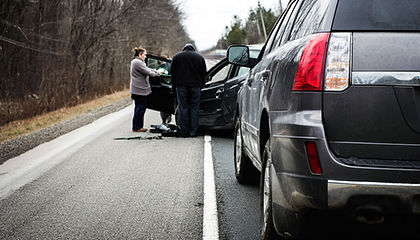
The most common type of car accident in New Hampshire: rear-end crashes frequently cause whiplash, back injuries, and concussions, even at low speeds. The rear driver is usually found at fault, but there are exceptions, and insurance companies regularly try to minimize the severity of these injuries.
Head-On Collisions

Head-on crashes carry the highest fatality rate of any accident type. Even when survivable, they typically cause catastrophic injuries including traumatic brain injuries, spinal cord damage, and multiple fractures. These cases often involve significant compensation due to the severity of injuries.
T-Bone and Side-Impact Collisions

Common at intersections, T-bone accidents are particularly dangerous because car doors offer limited protection compared to the front or rear of a vehicle. Occupants on the impact side frequently suffer broken ribs, pelvic injuries, and head trauma.

Rideshare accident claims involve a unique insurance structure with coverage that varies depending on whether the driver was logged into the app, en route to a passenger, or carrying a passenger. An attorney experienced in these cases understands how to navigate the multiple layers of insurance coverage.
Distracted Driving Accidents

Texting, phone use, eating, and other distractions are a leading cause of car accidents in New Hampshire. Distracted driving cases require careful investigation to prove the at-fault driver was not paying attention — cell phone records, witness testimony, and dash cam footage can all be critical evidence.
Hit-and-Run Accidents

When a driver flees the scene, you are left with serious injuries and no obvious source of recovery. New Hampshire’s mandatory uninsured motorist (UM) coverage under RSA 264:15 is often the key: it lets you recover under your own policy as if the fleeing driver were uninsured. Apis Law moves fast to pull surveillance and traffic-camera footage, canvass for witnesses, and work with law enforcement to identify the driver — while preserving your UM claim so you are protected even if the driver is never found.
Multi-Vehicle Pileups

Common on New Hampshire highways like I-93 and I-89, especially during winter weather. Multi-car accidents involve complex liability questions — multiple drivers, multiple insurance companies, and often conflicting accounts of what happened. These cases require experienced legal representation to sort out.
Winter Weather and Icy Road Accidents

New Hampshire's harsh winters create dangerous driving conditions. Icy roads, poor visibility, and snowstorms contribute to hundreds of accidents every year. While weather is a factor, drivers are still expected to adjust their speed and driving for conditions. In some cases, municipalities or road maintenance contractors may also bear liability for failure to properly treat roads.

Accidents involving semi-trucks, delivery vehicles, and other commercial vehicles often result in severe injuries due to the size and weight difference. These cases also involve additional legal complexity — federal trucking regulations, driver log requirements, and potentially liable parties including the driver, trucking company, and vehicle manufacturer.

In 2022, 36% of New Hampshire traffic deaths were alcohol-related, according to NHTSA data. Victims of drunk driving accidents may be entitled to both compensatory and punitive damages, since driving under the influence demonstrates reckless disregard for the safety of others.

Pedestrians hit by vehicles suffer devastating injuries and face insurance companies that move fast to minimize payouts. Apis Law investigates pedestrian accidents in Goffstown, Manchester, Nashua, and across NH, gathering surveillance footage and expert evidence to hold negligent drivers accountable.

Cyclists struck by vehicles suffer disproportionately severe injuries. New Hampshire law gives pedestrians the right of way in crosswalks, and drivers who fail to yield can be held liable for resulting injuries and damages.
Pedestrian Rights Under New Hampshire Law
Pedestrian accident cases in New Hampshire are governed by specific statutes that define both pedestrian rights and driver obligations. Understanding these rules is critical to proving liability when a driver strikes a pedestrian.
Crosswalk Protections
Under RSA 265:35, drivers must yield the right of way — by slowing down or stopping — to a pedestrian crossing within a crosswalk when the pedestrian is approaching so closely as to be in danger. Drivers are also prohibited from overtaking and passing any vehicle that has stopped at a crosswalk to let a pedestrian cross.
Driver’s Duty of Due Care
Regardless of whether the pedestrian is in a crosswalk or not, RSA 265:37 requires all drivers to exercise due care to avoid colliding with any pedestrian. Drivers must give an audible signal when necessary and exercise proper precaution if they observe any child or any obviously confused, incapacitated, or intoxicated person. This statutory duty of due care applies in every pedestrian accident case.
Pedestrian Responsibilities
Pedestrians also have obligations under NH law. A pedestrian may not suddenly leave a curb or other place of safety and walk or run into the path of a vehicle so close as to constitute an immediate hazard (RSA 265:35). When crossing outside of a crosswalk, pedestrians must yield the right of way to vehicles. However, these pedestrian duties do not eliminate the driver’s independent obligation to exercise due care.
Attorney Diaz’s Approach: In pedestrian accident cases, we investigate the exact location of the collision, the availability and condition of crosswalks, traffic signal timing, sight lines, driver speed, and whether the driver was distracted. We gather surveillance footage, witness statements, and accident reconstruction evidence to prove the driver breached their statutory duty.
Speaking with Police After
an Accident
When you speak with law enforcement after a New Hampshire car accident, give clear and factual details. This matters because the police report becomes key evidence for your car accident lawyer when you pursue an insurance claim or a personal injury case.
The officer will ask what happened. When you answer, stay brief and stick to facts. Do not guess, assume, or speculate. Always tell the truth. Then, give the officer your contact and insurance information. Share any witness details as well. If you suffered injuries, make sure to tell the officer so it appears in the report.
The police create a traffic accident report after a car accident, and this report gives the basic facts that your attorney and the insurance adjuster will review. If you were in a truck or motorcycle accident, the investigation may take longer and require more detail. Because of this, you should cooperate with the officer and make sure all important facts are included in the report.
This report matters. It supports your claims for property damage, medical bills, lost wages, and pain and suffering. It also gives your personal injury lawyer a strong starting point for your case.
This police report often becomes key evidence for your car accident lawyer in New Hampshire when pursuing an insurance claim or lawsuit.

How NH Courts Evaluate Driver Negligence
A knowledgeable New Hampshire attorney can evaluate your claim and build strong proof of fault. Whether you suffered whiplash, a spine injury, fractures, a traumatic brain injury, or any other physical injury, you must show that the other driver’s negligence caused the crash. With the right guidance, you can present clear evidence and protect your rights.
The Legal Duties Every NH Driver Owes You
Duty of Lookout and Control
Under NH law, every driver must remain alert, keep a proper lookout, pay attention to existing and potential hazards, and maintain control of the vehicle at all times. This is not a vague expectation. NH courts have held that the duty to keep a proper lookout includes the obligation not only to look, but to look carefully so as to observe oncoming traffic. A driver who fails to watch the road, check mirrors, or adjust for conditions like sun glare breaches this duty. See Johnston v. Lynch, 133 N.H. 79 (1990); Mullin v. Joy, 145 N.H. 96 (2000).
Duty to Drive at a Reasonable and Prudent Speed
New Hampshire requires every driver to operate at a speed that is reasonable and prudent for conditions. This means controlling speed to avoid striking pedestrians and other vehicles already on the roadway. Speed must be reduced when approaching intersections, curves, hillcrests, and narrow or winding roads, and wherever a special hazard exists due to pedestrians, weather, or highway conditions. Exceeding the speed limit is evidence of negligence, but the core question a jury decides is whether the driver’s speed was reasonable under the circumstances. See RSA 265:60; Chellman v. Saab-Scania AB, 138 N.H. 73 (1993).
Duty to Maintain a Safe Following Distance
Under RSA 265:25, all drivers must leave a reasonable and prudent distance between their vehicle and the one ahead, taking into account the speed of both vehicles, traffic volume, and road conditions. When the driver behind you does not leave enough room and rear-ends your car, they have violated this duty. Your attorney can use this specific legal standard to establish liability.
Duty at Intersections
Intersection accidents are governed by specific rules. Under RSA 265:28, a driver approaching an intersection from the left must yield the right of way to any driver on the right, unless a traffic control device or officer directs otherwise. A driver approaching a stop sign must come to a complete stop and yield to approaching traffic before proceeding (RSA 265:30). A driver intending to turn left must approach in the extreme left-hand lane and yield to oncoming traffic. When another driver violates these duties and causes a collision, the breach of the specific statutory rule is strong evidence of negligence.
Duty in Winter and Adverse Conditions
NH courts recognize that skidding does not automatically establish fault. However, if a driver knew or should have known that conditions made a skid likely — considering road surface, weather, speed, braking, and tire condition — and failed to adjust, the jury can find negligence. Drivers in New Hampshire are expected to reduce speed and take precautions appropriate for icy, snowy, or wet road conditions. See Grigas v. Merrimack Farmers’ Exchange, 94 N.H. 232 (1946).
Why This Matters for Your Case: When Attorney Diaz evaluates your car accident, he identifies the specific legal duties the at-fault driver violated. These are the same duties a judge will explain to a jury if your case goes to trial. Building your claim around these established standards gives it the strongest possible foundation.
Enhanced Accident Type Descriptions
Rear-End Collisions
Rear-end collisions are the most common type of car accident in New Hampshire. Under RSA 265:25, every driver must maintain a reasonable and prudent following distance based on speed, traffic, and road conditions. When a driver follows too closely and strikes the vehicle ahead, that driver has violated this statutory duty. Rear-end crashes frequently cause whiplash, back injuries, and concussions, even at low speeds. Insurance companies regularly minimize rear-end crash injuries, but the legal standard for liability is clear.
Intersection and T-Bone Collisions
Intersection accidents involve specific statutory duties. Under RSA 265:28, drivers approaching from the left must yield the right of way to drivers on the right. Drivers facing a stop sign must come to a complete stop and yield to all approaching traffic before proceeding (RSA 265:30–31). Drivers making left turns must yield to oncoming traffic. When a driver runs a red light, blows through a stop sign, or turns left into oncoming traffic, they have violated a clear statutory duty. T-bone collisions at intersections are particularly dangerous because car doors offer limited side-impact protection, often resulting in broken ribs, pelvic injuries, and head trauma.
Winter Weather and Skidding Accidents
New Hampshire’s winters create hazardous driving conditions. Under NH law, the fact that a vehicle skidded does not automatically mean the driver was at fault. However, the jury considers whether the driver knew or should have known that a skid was likely given the road conditions, weather, speed, and vehicle condition. Drivers are expected to reduce speed and adjust their driving for icy, snowy, and wet roads. When they fail to do so and cause a crash, they can be held liable. In some cases, municipalities or road maintenance contractors may also bear responsibility for failure to properly treat roads. See Grigas v. Merrimack Farmers’ Exchange, 94 N.H. 232 (1946).
Distracted Driving Accidents
A distracted driver who takes their eyes off the road, even briefly, violates the fundamental common-law duty of lookout and control that NH law imposes on every motorist. Under NH legal standards, every driver must remain alert, keep a proper lookout, and pay attention to existing and potential hazards at all times. Texting, phone use, and other distractions directly breach this duty. Proving distraction requires investigation — cell phone records, witness testimony, dash cam footage, and event data recorder evidence can all demonstrate that the at-fault driver was not paying attention.
Comparative Fault
What It Really Means for Your Recovery
How Fault Is Shared Under New Hampshire’s Comparative Fault Law
One of the most critical rules in any NH car accident case is the comparative fault statute, RSA 507:7-d. Insurance companies understand this rule well — and they use it aggressively to reduce or eliminate what they owe you.
Here is how it works: Under NH’s modified comparative fault system, you can recover damages as long as your share of fault does not exceed the combined fault of all defendants. If you are found 50% at fault or less, you can still recover, but your award is reduced by your percentage of responsibility. If you are found 51% or more at fault, you recover nothing.
How Juries Actually Apply This Rule
When a car accident case goes to trial in New Hampshire, the judge instructs the jury using a special verdict form. The jury answers specific questions: Was the defendant legally at fault? Was the plaintiff legally at fault? If both, what percentage of fault does each party bear? The jury then determines the full amount of your damages without regard to fault, and the judge reduces the award based on the percentages.
For example, if the jury finds you 30% at fault and the defendant 70% at fault, and your total damages are $100,000, the court reduces your recovery by 30%. You would receive $70,000. But if the percentages were reversed — you at 70% and the defendant at 30% — you would recover nothing.
Why Insurance Adjusters Push Hard on Comparative Fault
This is exactly why insurance adjusters work so hard to shift blame onto you. Even moving your fault percentage from 20% to 40% cuts your recovery in half. And if they can push it above 50%, they pay nothing. Common tactics include pointing to your speed, claiming you were distracted, arguing you failed to brake in time, or suggesting you were not wearing a seatbelt. An experienced NH car accident attorney recognizes these strategies and builds the factual record to counter them.
The NH Supreme Court has confirmed that when a defendant claims the plaintiff shares fault, the defendant carries the burden of proving that claim by a preponderance of the evidence. See Broughton v. Proulx, 152 N.H. 549 (2005). This means the insurance company cannot simply make accusations — they must back them up with evidence. Your attorney’s job is to make sure the evidence tells the full story.
Practical Tip: If the other driver’s insurer suggests you were partly at fault, do not agree or speculate. Anything you say can be used to inflate your fault percentage. Let your attorney handle these conversations.
Understanding Damages in NH Car Accident Cases
What New Hampshire Law Allows You to Recover
In a personal injury case arising from a car accident, New Hampshire law entitles you to full, fair, and adequate compensation for all losses caused by the defendant’s fault. The categories of damages are broader than most people realize.
Economic Damages
Economic damages cover your measurable financial losses. Under NH jury instructions, these include the reasonable value of medical care, hospital stays, nursing services, and supplies required to treat your injuries, both past and future. They also include lost wages: the present value of earnings you lost because of the accident and any future earning capacity you have lost due to permanent impairment. See Vachon v. New England Towing, Inc., 148 N.H. 429 (2002).
You do not need to prove future lost earnings with mathematical certainty. You need to present evidence that allows a jury to arrive at a reasonable pecuniary value for the loss. See Porter v. City of Manchester, 151 N.H. 30 (2004).
Pain and Suffering
Non-economic damages compensate you for the human toll of the accident. Under NH law, this includes physical pain, discomfort, fears, anxiety, mental and emotional distress, and loss of enjoyment of life. There is no fixed formula or mathematical calculation for pain and suffering — the jury exercises reasonable judgment based on the evidence. This is one of the most important areas where an experienced trial attorney can make a difference, because presenting pain and suffering effectively requires skill.
Loss of Enjoyment of Life
New Hampshire recognizes a separate category called hedonic damages in cases involving permanent injuries. This compensates you for the inability to carry on and enjoy life in the manner you did before the accident. Hedonic damages are distinct from pain and suffering and distinct from economic losses. They address activities, hobbies, and daily pleasures that your injuries have taken from you. See Bennett v. Lembo, 145 N.H. 276 (2000).
Aggravation of Preexisting Conditions
You are entitled to recover damages if the accident aggravated a medical condition you already had — even if a healthy person would not have been injured at all. Under NH law, the defendant takes the plaintiff as they find them. If you had a prior back condition and the accident made it significantly worse, you can recover for the additional harm caused by the aggravation. Your damages are limited to the worsening, not the preexisting condition itself. See Peterson v. Gray, 137 N.H. 374 (1993).
Insurance Company Tactic: Insurers routinely argue that your injuries are “preexisting” to avoid full payment. NH law says the at-fault driver is responsible for making your condition worse, even if you were already vulnerable. Your attorney documents the difference between your pre-accident condition and your post-accident condition to counter this argument.
Loss of Consortium
If your injuries have affected your relationship with your spouse — including loss of companionship, affection, comfort, sexual relations, or household services — your spouse may have an independent claim for loss of consortium under RSA 507:8-a. This is a separate claim from your own and adds an additional dimension to your household’s total recovery.
Duty to Mitigate
NH law requires injured persons to take reasonable steps to care for their injuries and prevent them from getting worse. This does not mean you must undergo risky surgery or endure extreme hardship. It means you should follow your doctor’s treatment recommendations and attend prescribed therapy. If you fail to mitigate without good reason, the defendant may argue that some portion of your damages was avoidable. See Kelleher v. Marvin Lumber & Cedar Co., 152 N.H. 813 (2005).
How New Hampshire Law Determines Total Loss Value and How to Challenge It
Free Total Loss Checklist
Because this process is technical, we created a simple, plain-English Ins 1002.15 Total Loss Checklist you can use to see whether the insurer followed the rules and to understand exactly what you can submit to challenge a low valuation. You can download it here for free and use it as a step-by-step guide.
When an insurance company declares your car a total loss in New Hampshire, they do not get to “ballpark” the value or rely on far-away listings. State law is very specific.
Under N.H. Admin. Code § Ins 1002.15, the insurer must determine your car’s actual cash value using local market data, within 75 miles. If they use comparable vehicles, those vehicles must be the same (or truly similar) make, model, and year, and they must be recent. Pulling a car from 200 miles away or outside the region without explanation is not how the law works.
Just as important, the law gives you a clear right to push back. If you disagree with the insurer’s number, you have 20 days to submit qualifying evidence. That evidence must come from very specific sources, such as documented local sales or written quotes from licensed dealers, and if you do it correctly, the insurer is legally required to recalculate the value, not just “meet you in the middle.” This is not a negotiation trick. It is a regulatory process that insurers must follow.
When we represent clients in personal injury claims, we regularly assist with total-loss valuation disputes and ACV challenges at no additional cost. Making sure you are paid the full, lawful value of your vehicle is part of holding insurance companies accountable, and it should not be any harder than the law already requires. If your total loss number does not look right, it is worth checking.
About the Author
Keith F. Diaz, Esq. | New Hampshire Bar No. 15831
Attorney Keith F. Diaz has practiced law in New Hampshire since 2003. He began his career as a criminal prosecutor in Rockingham County before transitioning to civil litigation in 2005. Today he represents individuals in personal injury and employment law matters throughout Southern New Hampshire. He is admitted to practice before the New Hampshire Supreme Court, the New Hampshire Superior and Circuit Courts, the United States District Court for the District of New Hampshire, and First Circuit Court of Appeals. He founded Apis Law in 2022.
Call Now 603-785-1013

Frequently Asked New Hampshire Car Accident Questions
What should I do after a car accident in New Hampshire?
Stop at the scene and call 911. Under RSA 264:25, I, a driver who knows or should have known of an accident involving death, injury, or property damage must stop immediately and give their name, address, license number, insurance provider and policy information, vehicle registration, and the name and address of each occupant. Get medical attention the same day even if you feel fine. Photograph the vehicles, the roadway, and the weather. Collect witness names. If anyone is injured or killed, or property damage exceeds $1,000, a written report is due to the Division of Motor Vehicles within 15 days, unless a police officer investigates the crash, in which case the officer's report satisfies the requirement. Read the full what to do after a car accident checklist.
Is New Hampshire a no-fault state for car accidents?
No. New Hampshire is a fault state. The driver who caused the crash, and that driver's insurer, are responsible for the harm. New Hampshire also does not require that a vehicle be insured before it is driven. The Financial Responsibility Act, RSA chapter 264, is written to induce rather than compel drivers to carry security, and proof of financial responsibility is required only in specific situations, such as after certain convictions or after causing an accident. That is why the coverage on your own policy often decides what a crash claim is actually worth.
What is New Hampshire's comparative negligence rule?
You can still recover if you were partly at fault, as long as your share is not the larger one. RSA 507:7-d provides that contributory fault does not bar recovery if that fault "was not greater than the fault of the defendant, or the defendants in the aggregate if recovery is allowed against more than one defendant," and that damages are then reduced in proportion to your share. So fault of 50 percent or less still recovers, reduced by that percentage, while 51 percent recovers nothing. In Broughton v. Proulx, 152 N.H. 549 (2005), the New Hampshire Supreme Court approved an instruction that a plaintiff is entitled to place some reliance on the defendant's performance of a duty of care. More on comparative fault in New Hampshire.
How long do I have to file a car accident claim in New Hampshire?
Three years. RSA 508:4, I allows personal actions to be brought "only within 3 years of the act or omission complained of," with a discovery rule for an injury that could not reasonably have been found at the time. Note the wording: the clock runs from the act, not from the day you learned the full extent of your injury. Different deadlines apply to claims against a city, town, or state agency, and those are much shorter. Waiting also costs evidence. Vehicles get repaired, video is overwritten on a 30-day cycle, and memories fade. See the New Hampshire personal injury statute of limitations.
What if the other driver does not have insurance?
You may have a claim against your own policy. RSA 264:15, I requires that every motor vehicle policy issued for a vehicle registered or principally garaged in New Hampshire carry uninsured motorist coverage at least equal to the liability minimums, and if you bought liability limits above the minimum, your uninsured motorist coverage automatically matches them. Hit-and-run drivers are covered as well. One provision matters before you sign anything: RSA 264:15, V requires every bodily injury release to carry a warning, in the document itself, that signing may forfeit your uninsured motorist benefits. If a release is in front of you, get advice before you sign it.
Should I give the other driver's insurance company a recorded statement?
Not before you get advice. Nothing requires you to give the other driver's insurer a recorded statement, and the questions are built around fault and injury history. Because RSA 507:7-d reduces your recovery by your percentage of fault and bars it entirely above 50 percent, every sentence you give about speed, distance, or what you did before the crash has a dollar value attached to it. The same is true of statements about prior injuries, which get used to argue your symptoms predate the collision. Apis Law handles insurer communication directly. Call (603) 785-1013 before you speak to an adjuster.
How much is my car accident case worth in New Hampshire?
Value tracks the evidence: the severity and permanence of the injury, the medical treatment and its reasonable cost, lost wages and lost earning capacity, and your share of fault. New Hampshire permits recovery for the reasonable value of past and future medical care and for pain, discomfort, anxiety, and emotional distress. See Johnston v. Lynch, 133 N.H. 79 (1990). Loss of enjoyment of life is recoverable as well, both for permanent and for temporary impairment. See Bennett v. Lembo, 145 N.H. 276 (2000), and Stachulski v. Apple New England, 171 N.H. 158 (2018). Future damages must be more probable than not, not speculative. And no lawyer can price a case by formula: Duguay v. Gelinas, 104 N.H. 182 (1962), rejects per diem arithmetic for pain and suffering. Apis Law resolved a Manchester crash claim for $95,000 despite a significant gap in treatment. Read how. Past results do not guarantee future outcomes. For an evaluation of your own case, call (603) 785-1013.
What happens if my car is totaled?
A total loss and an injury claim are two separate claims, and settling one does not settle the other. The property damage claim covers the actual cash value of the vehicle immediately before the crash, plus related costs. The injury claim is governed by the three-year deadline in RSA 508:4 and is unaffected by how quickly you resolve the vehicle. Insurers frequently offer a property settlement first, while the injury claim is still developing. Sign only the property release. See what to do when your car is totaled.
Related Pages
New Hampshire Litigation
Why Clients Choose Apis Law
No case managers. No paralegal runaround. Keith F. Diaz handles your case personally and returns your calls the same day.
Since 2003
2
Practice Areas
1
Attorney on Your Case
📍
New Hampshire Litigation Experience
Decades of experience in New Hampshire courts — from superior court to federal district court — providing practical insight into local rules, procedures, and judicial expectations across every county.
✅
Focused Practice Areas
Concentrated practice in personal injury, wrongful termination, and workplace discrimination — enabling precise issue spotting and effective case development.
📋
Evidence-Driven Case Strategy
Every matter is built on documentation, witness testimony, expert analysis, and a realistic assessment of how courts, insurers, and opposing counsel evaluate risk. Strategy grounded in facts and law — not assumptions.
👨🏾⚖️
Direct Access to Your Attorney
Work directly with the attorney handling your case. No layers of case managers or junior associates. Communication is direct, timely, and structured to support informed decision-making.
⚖️
Prepared for Settlement or Trial
Cases are developed with litigation in mind from day one. Whether a matter resolves through negotiation, mediation, or trial, Apis Law prepares each case as if it will be presented in court.
📞
If you are looking for an experienced New Hampshire litigation lawyer to evaluate a personal injury claim or employment law dispute, Apis Law is prepared to review your case and explain your legal options.