
What to Do After a Car Accident
in New Hampshire
A Step-by-Step Guide to Protecting Your Health, Your Rights, and Your Claim
The minutes, hours, and days after a car accident are critical. What you do, and what you avoid doing, can make the difference between a fully compensated personal injury claim and one that falls apart. This guide walks you through every step, with specific guidance for New Hampshire drivers.
Step 1: Stop, Stay, and Check for Injuries

New Hampshire law requires every driver involved in an accident to stop immediately and remain at the scene. Leaving the scene of an accident, especially one involving injuries, is a serious criminal offense under RSA 264:25.
Before anything else, check yourself and your passengers for injuries. If anyone is hurt, call 911 immediately. Even if the injuries seem minor, err on the side of caution. Adrenaline can mask pain, and some serious injuries, including traumatic brain injuries, internal bleeding, and spinal cord damage, may not produce obvious symptoms right away.
If it is safe to do so, move your vehicle out of the travel lanes to prevent secondary collisions. New Hampshire’s expedited clearance statute (RSA 264:25-a) encourages drivers to clear the roadway when possible without jeopardizing safety or evidence.
Step 2: Call the Police
Always call the police after a car accident in New Hampshire, even if the crash seems minor. A police report creates an official record of the accident that will be important for your insurance claim and any potential lawsuit.
NH reporting requirement: Under RSA 264:25, any motor vehicle accident involving death, personal injury, or combined property damage, exceeding $1,000 must be reported to the New Hampshire Division of Motor Vehicles within 15 days.
If the police respond to the scene and file a report, that satisfies this requirement. If the police do not respond, you are responsible for filing a written Operator’s Report (Form DSMV 400) with the DMV yourself.
Failure to Report Is a Crime. Failure to report an accident involving death or personal injury is a crime in New Hampshire. Failure to report a property damage accident is a misdemeanor. Additionally, failure to report can result in suspension of your driver’s license and vehicle registration.
Step 3: Exchange Information
While at the scene, exchange the following information with every other driver involved:
✅ Full legal name, address, and phone number
✅ Driver’s license number and issuing state
✅ Vehicle make, model, year, color, and license plate number
✅ Insurance company name and policy number (if they have insurance)
✅ Name and contact information of the vehicle owner, if different from the driver
NH Currently Does not have Mandatory Auto Insurance
New Hampshire is the only state in the country that does not require drivers to carry auto insurance. This means the driver who hit you may be completely uninsured. If the other driver does not have insurance, do not panic — but do make note of it. Your own uninsured motorist (UM) coverage may apply, and there are legal options available to pursue compensation from an uninsured at-fault driver. This is one of the many reasons why consulting with an attorney after an accident in New Hampshire is especially important.
Step 4: Document the Scene
The evidence you collect at the accident scene can make or break your claim. Insurance companies and defense attorneys will scrutinize every detail, so thorough documentation is critical. If you are physically able, do the following:

Photograph Everything
✅ All vehicles involved — capture damage from multiple angles, including close-ups and wide shots showing the vehicles’ positions relative to each other
✅ The roadway — skid marks, debris, gouges in the pavement, broken glass, and fluid spills
✅ Traffic controls — stop signs, traffic lights, yield signs, lane markings, and speed limit signs
✅ Road conditions — potholes, ice, wet pavement, construction zones, obscured signage, or poor visibility
✅ Your injuries — visible cuts, bruises, swelling, and any blood on your clothing or in your vehicle
✅ The surrounding area — nearby businesses (which may have surveillance cameras), intersections, and landmarks
Collect Witness Information
If anyone witnessed the accident, ask for their name, phone number, and email address. Witness testimony can be decisive in disputes over who was at fault. Witnesses have a tendency to disappear after leaving the scene, so capture their contact information before they leave.
Write Down Your Own Account
As soon as possible, ideally while still at or near the scene, write down or record a voice memo describing exactly what happened. Include the direction you were traveling, your speed, what you observed before the impact, the weather and lighting conditions, and anything the other driver said. Memories fade quickly, and your own contemporaneous account is powerful evidence.
Step 5: Seek Medical Attention — Even If You Feel Fine
This is one of the most important steps and the one people most often skip. After an accident, adrenaline and shock can mask serious injuries. Many of the most dangerous conditions, including concussions, internal bleeding, herniated discs, and soft tissue damage, may not produce noticeable symptoms for hours or even days.
Visit an emergency room, urgent care facility, or your primary care physician as soon as possible after the accident. A prompt medical evaluation accomplishes two critical things:
• It protects your health by identifying injuries that may not yet be symptomatic
• It creates a medical record linking your injuries to the accident, which is essential for your claim
The insurance company will use gaps in treatment against you. If you wait days or weeks to see a doctor, the insurer will argue that your injuries were either not caused by the accident or are not as serious as you claim. A same-day or next-day medical visit eliminates this argument. Follow your doctor’s treatment plan completely. Attend every appointment, fill every prescription, and complete every course of physical therapy. Any gaps in treatment give the insurance company ammunition to devalue your claim.
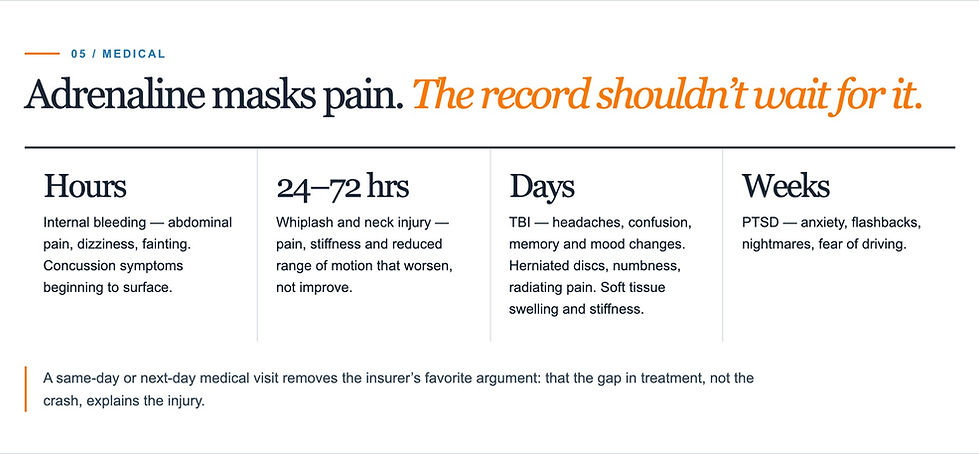
Common Delayed-Onset Injuries from Car Accidents
⚠️ Concussion and traumatic brain injury (TBI) — headaches, confusion, memory problems, and mood changes that may appear days later
⚠️ Whiplash and neck injuries — pain, stiffness, and reduced range of motion that worsen over the first 24–72 hours
⚠️ Herniated discs and spinal injuries — back pain, numbness, and radiating pain down the arms or legs
⚠️ Internal bleeding — abdominal pain, dizziness, and fainting that may not appear immediately
⚠️ Soft tissue injuries — sprains, strains, and tears to muscles, tendons, and ligaments that swell and stiffen over time
⚠️ Post-traumatic stress disorder (PTSD) — anxiety, flashbacks, nightmares, and driving-related fear that may develop in the weeks following the accident
Step 6: Notify Your Insurance Company
Report the accident to your own insurance company promptly. Most policies require timely notification as a condition of coverage. When you report the accident:
• Stick to the basic facts — when, where, and what vehicles were involved
• Do not speculate about fault or give opinions about what happened
• Do not minimize or exaggerate your injuries
• Do not provide a recorded statement without consulting an attorney first
Important: Notifying your own insurer is different from dealing with the other driver’s insurance company. You have contractual obligations to your own insurer. You have no obligation to speak with the other driver’s insurer at all, and you should not do so without legal guidance.

Step 7: Do NOT Give a Recorded Statement to the Other Driver’s Insurance Company
This is the single biggest mistake people make after a car accident. Within days of the crash, sometimes within hours, you will likely receive a phone call from the at-fault driver’s insurance company. The adjuster will sound friendly and sympathetic. They will tell you the recorded statement is “routine” and “just to get your side of the story.”
The truth is that the recorded statement is a tool designed to reduce or eliminate your claim. The adjuster is trained to ask questions that lead you into making statements that can be used against you:
❗️ “Could you have done anything differently to avoid the accident?” — designed to establish comparative fault
❗️ “How are you feeling today?” — if you say “fine” or “okay,” they will use it to argue your injuries are minor
❗️ “Where exactly does it hurt?” — any body part you fail to mention can later be excluded from your claim
❗️ “Did you see the other car before the impact?” — designed to suggest you were inattentive
You are not required to give a recorded statement to the other driver’s insurance company. Politely decline and tell them to contact your attorney.

Step 8: Document the Scene
From the moment of the accident forward, you should be building a file that documents every aspect of your injuries and their impact on your life. The more organized and thorough your records are, the stronger your claim will be.
What to Track
✅ Out-of-pocket expenses — co-pays, medications, medical equipment (braces, crutches, etc.), mileage to medical appointments, and parking fees
✅ Lost wages documentation — pay stubs, employer letters confirming time missed, and any documentation of reduced hours or lost overtime
✅ A daily pain journal — record your pain levels (on a 1–10 scale), what activities you can and cannot do, how your injuries affect your sleep, mood, and relationships, and any emotional symptoms like anxiety or depression
✅ Photographs of your injuries — take photos every few days to document bruising, swelling, surgical incisions, and the healing process
✅ Vehicle repair estimates and invoices — or documentation of total loss value
✅ Correspondence — save every letter, email, and note from insurance companies, medical providers, and anyone else involved in your case
Step 9: Be Careful with Social Media
Insurance companies and defense attorneys routinely monitor claimants’ social media accounts. Anything you post can and will be used against you. A photo of you smiling at a family gathering can be twisted to suggest you’re not in pain. A check-in at a restaurant can be used to argue that your injuries don’t limit your activities. Even an innocent comment like “I’m doing better today!” can be taken out of context.
✅ Do not post about the accident, your injuries, your medical treatment, or your legal case
✅ Do not accept friend or follow requests from people you do not know
✅ Ask friends and family not to tag you in posts or photos
✅ Consider setting all accounts to private, but understand that even private posts may be discoverable in litigation
✅ The safest approach is to stay off social media entirely until your case is resolved
Step 10: Consult with a Personal Injury Attorney
New Hampshire’s legal landscape for car accidents is more complex than most people realize. As the only state without mandatory auto insurance, New Hampshire presents unique challenges for accident victims. The modified comparative fault system means the insurance company has a financial incentive to blame you for the accident. And the three-year statute of limitations under RSA 508:4 means the clock is ticking from the moment the accident happens.
An experienced personal injury attorney can:
✅ Evaluate your claim and identify all potentially liable parties and available insurance coverage
✅ Handle all communication with insurance companies so you don’t say something that damages your case
✅ Investigate the accident independently — gathering evidence, interviewing witnesses, and consulting with accident reconstruction experts
✅ Determine the full value of your claim, including medical expenses, lost wages, future treatment costs, pain and suffering, and other non-economic damages
✅ Negotiate aggressively with the insurance company from a position of strength
✅ File a lawsuit and take your case to trial if the insurance company refuses to offer fair compensation
When to call: As soon as possible after the accident. Evidence is freshest, witnesses are most available, and early attorney involvement prevents the costly mistakes that can undermine your claim. Most personal injury attorneys, including our firm, offer free initial consultations, so there is no financial risk in making the call.
Key New Hampshire Laws Every Driver Should Know
New Hampshire has several laws that directly affect how car accident claims work. Understanding these rules is essential to protecting your rights after a crash.

No Mandatory Auto Insurance
New Hampshire is the only state in the country that does not require drivers to carry auto insurance. While most New Hampshire drivers do carry coverage voluntarily, the uninsured motorist rate is still a real concern. If you are hit by an uninsured driver, your options for recovery include your own uninsured motorist (UM) coverage (if you carry it), a direct claim or lawsuit against the at-fault driver personally, and MedPay coverage under your own policy (minimum $1,000 is required if you have a policy under RSA 264:16).
If you do carry insurance in New Hampshire, your policy must include minimum coverage of $25,000 per person / $50,000 per accident for bodily injury liability, $25,000 for property damage liability, uninsured/underinsured motorist coverage matching your liability limits, and at least $1,000 in Medical Payments (MedPay) coverage.
At-Fault System
New Hampshire is an at-fault (tort) state, meaning the driver who caused the accident is responsible for paying damages. Unlike no-fault states, like Massachusetts, where you file claims with your own insurer regardless of who caused the crash, New Hampshire allows you to file a claim directly against the at-fault driver’s insurance company or bring a lawsuit to recover your full damages, including pain and suffering.
Comparative Fault (RSA 507:7-d)
Under New Hampshire’s modified comparative fault rule, you can still recover damages even if you were partially at fault for the accident — as long as your fault does not exceed the fault of the other driver (or the combined fault of all defendants). Your award is reduced by your percentage of fault. However, if you are found to be 51% or more at fault, you cannot recover anything. The insurance company will aggressively try to shift blame onto you to reduce or eliminate your claim.
You generally have three years from the date of the accident to file a personal injury lawsuit in New Hampshire. If you miss this deadline, the court will dismiss your case and you will lose your right to compensation permanently. Filing an insurance claim or negotiating with an adjuster does not stop or extend this deadline — only filing an actual lawsuit in court preserves your claim.
Accident Reporting (RSA 264:25)
Any accident involving death, personal injury, or combined property damage exceeding $1,000 must be reported to the New Hampshire Division of Motor Vehicles within 15 days. A police report filed by the responding officer satisfies this requirement. If no officer responds, you must file the Operator’s Report (Form DSMV 400) yourself. Failure to report is a felony if death or injury is involved, and a misdemeanor for property-damage-only accidents.
No Mandatory Seatbelt Law for Adults
New Hampshire is the only state that does not require adult drivers and passengers to wear seatbelts. While this means you won’t receive a citation for not wearing one, the defense may still attempt to argue that your injuries were worsened by the lack of a seatbelt. This is a contested area of New Hampshire personal injury law that requires careful handling by an experienced attorney.

Mistakes That Can Destroy Your Claim

Insurance companies look for any reason to deny or devalue your claim. Avoid these common mistakes:
1. Saying “I’m sorry” or “It was my fault” at the scene — even out of politeness, these statements can be used as admissions of fault
2. Waiting to see a doctor — delays in treatment create a gap the insurer will exploit to argue your injuries are unrelated to the accident or exaggerated
3. Giving a recorded statement to the other driver’s insurance company — anything you say can and will be used to reduce your claim
4. Posting on social media — photos, check-ins, and comments can all be taken out of context to undermine your case
5. Accepting a quick settlement offer — early offers are almost always far below the true value of your claim and come before you understand the full extent of your injuries
6. Signing a medical authorization — insurance companies may ask you to sign broad authorizations that give them access to your entire medical history, which they will comb through looking for pre-existing conditions to blame
7. Failing to file the DSMV 400 report — if the police did not respond to your accident and you don’t file within 15 days, you risk license suspension and weaken your claim
8. Waiting too long to hire an attorney — evidence disappears, witnesses forget, and the insurance company gains leverage the longer you go without representation
We’re Here to Help — From Day One
A car accident can upend your life in an instant. You’re dealing with pain, medical bills, a damaged vehicle, time away from work, and the stress of navigating an insurance system that is not designed to help you. You shouldn’t have to figure this out alone.
At Apis Law, we represent car accident victims throughout southern New Hampshire, including Goffstown, Manchester, Bedford, Nashua, Concord, Merrimack, Londonderry, Derry, and the surrounding communities. We understand New Hampshire’s unique legal landscape, from the absence of mandatory auto insurance to the comparative fault rules that insurance companies use to reduce your claim.
We handle every aspect of your case from the initial investigation through settlement or trial, so you can focus on your recovery. And because we work on a contingency fee basis, you pay nothing unless we win.
About the Author
Keith F. Diaz, Esq. | New Hampshire Bar No. 15831
Attorney Keith F. Diaz has practiced law in New Hampshire since 2003. He began his career as a criminal prosecutor in Rockingham County before transitioning to civil litigation in 2005. Today he represents individuals in personal injury and employment law matters throughout Southern New Hampshire. He is admitted to practice before the New Hampshire Supreme Court, the New Hampshire Superior and Circuit Courts, and the United States District Court for the District of New Hampshire. He founded Apis Law in 2022.
Call Now 603-785-1013

Frequently Asked Questions about What to Do After A Car Accident in New Hampshire
What should I do immediately after a car accident in New Hampshire?
Stop at the scene, check for injuries, and call the police. RSA 264:25, I requires a driver who knows or should have known of an accident causing death, personal injury, or property damage to stop immediately and give the other driver, any injured person, and any property owner the driver's name and address, driver's license number, insurance provider and policy information, the vehicle registration number, and the name and address of each occupant. If no one at the scene is able to receive that information, the statute requires you to give it to a uniformed police officer at the scene, or immediately at the nearest police station. Photograph the vehicles, the road, and any visible injury before anything is moved.
Do I have to report a car accident to the New Hampshire DMV?
Yes, within 15 days, unless police investigated the crash. RSA 264:25, I requires a written report to the division within 15 days if any person is injured or killed, or if property damage exceeds $1,000, "unless the accident is investigated by a police officer, in which case a report filed by such officer shall satisfy the requirements of this section." Failing to report is a misdemeanor for an individual, and a class B felony where death or personal injury results. RSA 264:29.
Should I speak to the other driver's insurance company?
You are not required to give the other driver's insurer a recorded statement. That carrier owes you nothing and is building its defense file. A statement taken days after a crash, before you know the extent of your injuries, produces answers such as "I'm fine" and "I'm not sure," which are quoted back later on both injury and fault. Your own policy is a different matter, because it generally contains a cooperation clause. Read that obligation before you decline anything.
Is New Hampshire a no-fault state?
No. New Hampshire is an at-fault state, so the driver responsible for the crash pays for the harm caused, through that driver's liability insurance. There is no no-fault system here that pays your medical bills regardless of blame. New Hampshire does require medical payments coverage of at least $1,000 per person on any private passenger auto policy issued in the state, for costs incurred within three years of the injury. RSA 264:16, I. Your own share of fault then reduces recovery under RSA 507:7-d.
What if the other driver does not have insurance?
Your own policy is often the answer. New Hampshire does not require every driver to carry liability insurance, but RSA 264:15, I requires that any policy issued for a vehicle registered or principally garaged in this state include uninsured motorist coverage, at limits at least equal to the liability coverage, protecting people "legally entitled to recover damages from owners or drivers of uninsured motor vehicles, and hit-and-run vehicles." A claim against your own carrier is a contract claim, and its deadline analysis is not the same as the deadline on the claim against the driver.
What if I feel fine after the crash but symptoms show up later?
Get evaluated anyway, and do it early. Soft tissue injuries, concussions, and internal injuries often produce no symptoms on the day of a crash, and adrenaline masks pain for hours. A gap between the crash and the first medical visit is the argument an adjuster uses to say the injury came from something else. New Hampshire's discovery rule can extend a filing deadline where an injury and its cause could not reasonably have been discovered at the time, but it is narrow and it is no substitute for treatment. RSA 508:4, I.
How long do I have to file a car accident lawsuit in New Hampshire?
Three years. RSA 508:4, I allows personal actions "only within 3 years of the act or omission complained of," which for a crash is the date of the collision. Filing an insurance claim does not satisfy that requirement; only filing suit in court does. Claims involving a city, town, or school district carry a separate 60-day notice requirement under RSA 507-B:7, I. The exceptions, including the discovery rule and the rule for minors, are set out on our New Hampshire statute of limitations page.
New Hampshire Litigation
Why Clients Choose Apis Law
No case managers. No paralegal runaround. Keith F. Diaz handles your case personally and returns your calls the same day.
Since 2003
2
Practice Areas
1
Attorney on Your Case
📍
New Hampshire Litigation Experience
Decades of experience in New Hampshire courts — from superior court to federal district court — providing practical insight into local rules, procedures, and judicial expectations across every county.
✅
Focused Practice Areas
Concentrated practice in personal injury, wrongful termination, and workplace discrimination disputes — enabling precise issue spotting and effective case development.
📋
Evidence-Driven Case Strategy
Every matter is built on documentation, witness testimony, expert analysis, and a realistic assessment of how courts, insurers, and opposing counsel evaluate risk. Strategy grounded in facts and law — not assumptions.
👨🏾⚖️
Direct Access to Your Attorney
Work directly with the attorney handling your case. No layers of case managers or junior associates. Communication is direct, timely, and structured to support informed decision-making.
⚖️
Prepared for Settlement or Trial
Cases are developed with litigation in mind from day one. Whether a matter resolves through negotiation, mediation, or trial, Apis Law prepares each case as if it will be presented in court.
📞
Contact Apis Law
If you are looking for an experienced New Hampshire litigation lawyer to evaluate a personal injury claim, employment law dispute, or real estate matter, Apis Law is prepared to review your case and explain your legal options.