
How to File a Sexual Harassment Complaint in New Hampshire


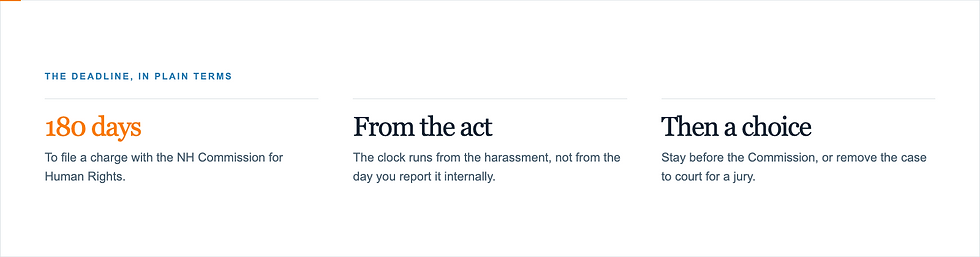
In New Hampshire, you have 180 days from the act of harassment to file a charge with the New Hampshire Commission for Human Rights, and filing there is the step that opens every other door.
You cannot walk into Superior Court and sue your employer for sexual harassment under state law without going through the Commission first. RSA 354-A:21, III sets the deadline, and it is short, 180 days. This post explains what the Commission is, exactly what happens after you file, when you can take the case to a jury instead, and what the Commission can and cannot award you.
The rule in one sentence
New Hampshire's Law Against Discrimination, RSA 354-A, makes sexual harassment a form of unlawful sex discrimination, and RSA 354-A:21, I(a) requires that a person claiming to be aggrieved "make, sign and file with the commission a verified complaint in writing." The statute defines the conduct at RSA 354-A:7, V: unwelcome sexual advances, requests for sexual favors, and other verbal or physical conduct of a sexual nature are unlawful when submission is made a term or condition of employment, when submission or rejection is used as the basis for an employment decision, or when the conduct has the purpose or effect of unreasonably interfering with work performance or creating an intimidating, hostile, or offensive working environment.
The federal definition at 29 C.F.R. § 1604.11 is written in nearly identical terms. That matters practically: New Hampshire courts read RSA 354-A against federal Title VII case law. In Madeja v. MPB Corp., 149 N.H. 371 (2003), the New Hampshire Supreme Court said so directly, noting that on an issue of first impression under RSA chapter 354-A it would "rely upon cases developed under Title VII to aid in our analysis."
Then the deadline. RSA 354-A:21, III: "Any complaint filed pursuant to this section by an aggrieved person must be filed within 180 days after the alleged act of discrimination." There is no good-cause extension written into the statute.
A worked timeline
Assume the last incident of harassment happened on March 1.
Day 1 (March 1). The 180-day clock starts.
Day 180 (late August). Last day to file a verified complaint with the New Hampshire Commission for Human Rights under RSA 354-A:21, III. Miss this and the state claim is likely gone.
Day 300 (late December). The New Hampshire Commission for Human Rights is a Fair Employment Practices Agency with a worksharing agreement with the EEOC, which extends the federal charge-filing window to 300 days. A charge filed with one agency is generally cross-filed with the other. The federal window can still be open after the state window has closed, but you should never plan around that.
Day 180 onward. Under RSA 354-A:21-a, I, you may withdraw from the Commission and file a civil action in Superior Court "at the expiration of 180 days after the timely filing of a complaint with the commission, or sooner if the commission assents in writing, but not later than 3 years after the alleged unlawful practice occurred."
After a federal Notice of Right to Sue. You have 90 days to file suit. That deadline is set by statute and is not negotiable.
Two clocks, two different lengths, and a third outer limit at three years for the Superior Court action.
If the 180-day date is close, contact Apis Law before you spend another week deciding.
How employers defend these cases
The Faragher/Ellerth affirmative defense. Where no tangible job action was taken against you, an employer can escape vicarious liability by proving two things: that it exercised reasonable care to prevent and promptly correct harassing behavior, and that you unreasonably failed to use the complaint procedure it provided. Faragher v. City of Boca Raton, 524 U.S. 775 (1998), and Burlington Industries v. Ellerth, 524 U.S. 742 (1998), created that defense on the same day. The defense disappears entirely when the harassment culminates in a firing, demotion, or reassignment. This is the single strongest reason to report in writing and keep a copy.
Arguing the harasser was not a supervisor. In Vance v. Ball State University, 570 U.S. 421 (2013), the Supreme Court held that a person is a "supervisor" for vicarious liability purposes only if the employer empowered them to take tangible employment actions. If the employer can recharacterize your harasser as a coworker, the claim drops into a negligence framework, which is easier to defend.
Arguing the conduct was not severe or pervasive. Employers frequently argue that you kept doing your job, so nothing was really wrong. The Supreme Court rejected the psychological-injury version of that argument in Harris v. Forklift Systems, Inc., 510 U.S. 17 (1993), holding that Title VII "comes into play before the harassing conduct leads to a nervous breakdown."
Pointing to your delay in reporting. Expect the employer to make your silence the issue. The First Circuit has held that a reasonable fear of reporting can defeat the second prong of the affirmative defense, including where the people you were required to report to were personal friends of the harasser. Monteagudo v. Asociacion de Empleados del Estado Libre Asociado de Puerto Rico, 554 F.3d 164 (1st Cir. 2009).
Papering the file after the fact. Once a complaint is made, negative performance documentation often appears. Date everything you have now.
What New Hampshire courts have held
Madeja v. MPB Corp., 149 N.H. 371 (2003)
The plaintiff told her supervisor that coworkers were complaining about her because she had rejected a male coworker's advances. The employer separated them and followed up. Eight days later she was fired, after a complaint from a friend of the alleged harasser. The New Hampshire Supreme Court upheld the jury's finding of liability and rejected the employer's argument that coworker retaliation cannot be an adverse employment action. The court held that actions falling short of ultimate employment decisions, including tolerating coworker retaliation, may be adverse employment actions; that an employer is liable if its supervisors knew or should have known of the retaliatory conduct and tolerated, condoned, or encouraged it; and that an employer may be liable for negligently failing to discover or remedy it. This is the New Hampshire case that makes what happens after you complain legally actionable in its own right.
EEOC v. Fred Fuller Oil Co., 168 N.H. 606 (2016)
Answering certified questions from the federal district court, the New Hampshire Supreme Court held that individuals, not only companies, can be personally liable under RSA 354-A for aiding and abetting discrimination and for retaliation. Under RSA 354-A:2 and RSA 354-A:7 for aiding and abetting, and RSA 354-A:19 for retaliation, the owner or manager who harassed you may be a defendant alongside the business. Note the six-employee threshold built into the statutory definition of employer, which shapes who can be reached. The case held that while an individual can be held liable for sexual harassment, the complainant must prove the six-employee threshold.
Godfrey v. Perkin-Elmer Corp., 794 F. Supp. 1179 (D.N.H. 1992)
The plaintiff was the only woman in a small branch office. She reported that supervisors stared at her, made sexually suggestive and demeaning remarks, and sat or stood inordinately close to her. Management made no attempt to investigate. She resigned on her physician's advice. The federal court in New Hampshire found she had been constructively discharged, that the employer's failure to investigate and remediate satisfied the bad-faith element of a wrongful discharge claim, and that she stated a claim for intentional infliction of emotional distress. The failure to investigate was the wrong.
E.D. Swett, Inc. v. N.H. Commission for Human Rights, 124 N.H. 404 (1983)
On remedies, the New Hampshire Supreme Court addressed the limit on back pay where a former employee refuses a reasonable offer of reinstatement. Back pay does not continue to accrue past the date of that offer. Expect an employer facing exposure to make one.
What actually happens after you file
Once your verified complaint is filed, the Commission notifies your employer and assigns an investigator. Under RSA 354-A:21, II(a), a designated commissioner makes a prompt investigation with staff assistance. The investigator requests information from both sides: correspondence, memoranda, personnel records, performance evaluations, warnings, witness statements, and workforce data. Witnesses are contacted and interviewed.
Along the way, the Commission may schedule a predetermination conference or offer mediation. The Commission's mediation program is free to the parties and is staffed by a volunteer panel of New Hampshire employment attorneys. It resolves a meaningful share of cases without a hearing.
The investigator then issues a report and a determination of whether there is probable cause to believe discrimination occurred. If probable cause is found, the case proceeds to a public hearing before three commissioners under RSA 354-A:21, unless either party removes it to Superior Court for a jury trial. If no probable cause is found and you did not remove the case, the complaint is dismissed subject to a right of appeal to Superior Court, where the question is whether the Commission's decision is unlawful or unreasonable by a clear preponderance of the evidence.
On remedies, RSA 354-A:21, II(d) empowers the Commission to order an employer to cease and desist, to take affirmative action including hiring, reinstatement, or upgrading with or without back pay, to pay compensatory damages to the complainant, and to pay an administrative fine.
Back pay is calculated under RSA 354-A:21, II(e) as what you would have earned but for the discrimination, less unemployment compensation and interim earnings. The statute does not authorize the Commission to award punitive damages. If you remove to Superior Court under RSA 354-A:21-a, the court may award enhanced compensatory damages in place of the administrative fine where the conduct was willful or in reckless disregard of the law, and a federal action can carry punitive damages under the Civil Rights Act of 1991. An award of attorneys fees can be in play too.
If you choose Superior Court, RSA 354-A:21-a, II requires you to notify the Commission, which then dismisses the administrative complaint without prejudice. You cannot run both at once, and once you elect the civil action you cannot go back and file a Commission complaint on the same practice.

Practical takeaways
Date the last incident and count forward 180 days. Put that date somewhere you will see it. Everything in RSA 354-A:21, III turns on it, and a well-documented claim filed on day 181 is worth less than a thin one filed on day 179.
Report in writing, and keep your own copy. The Faragher/Ellerth defense is built on the argument that you never used the employer's process. An email you sent from your personal account, or a printed acknowledgment, is the cheapest evidence you will ever gather. Assume you will lose access to your work email without warning.
Preserve what already exists. Texts, direct messages, schedules showing who worked which shifts, names of coworkers who saw or heard it, and any performance reviews predating your complaint. Under Madeja, what happens after you report can be its own claim, so keep the timeline of events that follow.
Do not sign a severance agreement or release before someone reads it. A release can extinguish the claim entirely. The federal Speak Out Act, enacted in 2022, bars enforcement of non-disclosure and non-disparagement clauses agreed to before a sexual harassment dispute arises, but it does not reach agreements signed to settle a dispute that already exists.
Frequently asked questions
How long do I have to file a sexual harassment complaint in New Hampshire?
You have 180 days from the alleged act of discrimination. RSA 354-A:21, III states that a complaint "must be filed within 180 days after the alleged act of discrimination." Because the New Hampshire Commission for Human Rights and the EEOC have a worksharing agreement, the federal charge-filing window is 300 days, so a federal claim can survive after the state deadline has passed. Do not plan around that gap.
Do I have to go to the Human Rights Commission before I can sue?
Yes, for a claim under RSA 354-A. You must first file a verified complaint with the Commission under RSA 354-A:21, I(a). RSA 354-A:21-a, I then lets you bring a civil action in Superior Court once 180 days have passed since filing, or sooner if the Commission assents in writing, but not later than three years after the unlawful practice occurred.
What can the Commission actually award me?
Under RSA 354-A:21, II(d), the Commission can order the employer to stop the conduct, to reinstate or upgrade you with or without back pay, to pay compensatory damages, and to pay an administrative fine. Back pay is calculated under RSA 354-A:21, II(e) as what you would have earned but for the discrimination, reduced by unemployment compensation and interim earnings. The statute does not authorize the Commission to award punitive damages. Attorney's fees are in play too.
Can I sue the individual who harassed me, not just the company?
Sometimes. In EEOC v. Fred Fuller Oil Co., 168 N.H. 606 (2016), the New Hampshire Supreme Court held that individuals can be personally liable under RSA 354-A for aiding and abetting discrimination and for retaliation. Whether that applies depends on the facts and on the statutory six-employee threshold, so it is worth a specific look at your situation.
What if my employer punishes me for complaining?
That can be a separate claim. In Madeja v. MPB Corp., 149 N.H. 371 (2003), the New Hampshire Supreme Court held that tolerating coworker retaliation can be an adverse employment action, and that an employer is liable if its supervisors knew or should have known of the retaliatory conduct and tolerated, condoned, or encouraged it. RSA 354-A:19 prohibits retaliation, and under Fred Fuller an individual can be liable for it.
External legal resources
New Hampshire Commission for Human Rights: the agency that receives and investigates state complaints.
RSA chapter 354-A, full text (New Hampshire General Court): the Law Against Discrimination, including the 180-day deadline and the remedies provisions.
EEOC, Time Limits for Filing a Charge: the federal 180-day and 300-day rules.
Related pages on apislaw.com
Practice areas
Related reading
Talk to Keith before the deadline runs
If you are weighing whether to file, the 180-day clock in RSA 354-A:21, III is already running. Apis Law represents employees in sexual harassment, discrimination, and retaliation matters throughout New Hampshire, from the Goffstown and Bedford offices and in Manchester, Concord, Nashua, and Hooksett. You speak directly with Keith, not an intake screener.
Call (603) 785-1013, request a free case review, or read more about Attorney Keith F. Diaz and Apis Law.

About the Author
Keith F. Diaz, Esq. is the founder of Apis Law, PLLC, a New Hampshire personal injury and employment law firm. Attorney Diaz has been practicing in New Hampshire since 2003 and is admitted to practice in the State of New Hampshire (Bar No. 15831), the U.S. District Court for the District of New Hampshire, and the First Circuit Court of Appeals. He founded Apis Law in 2022 to provide dedicated, client-focused representation to individuals and families throughout New Hampshire.
This article is general information about New Hampshire law and is not legal advice. Reading it does not create an attorney-client relationship. Deadlines and outcomes depend on the specific facts of a case. If you believe you have been harassed at work, speak with a lawyer about your own situation.


Comments